

is everyone an engineer now?
the rise of the marketing engineer, content engineer, GTM engineer...

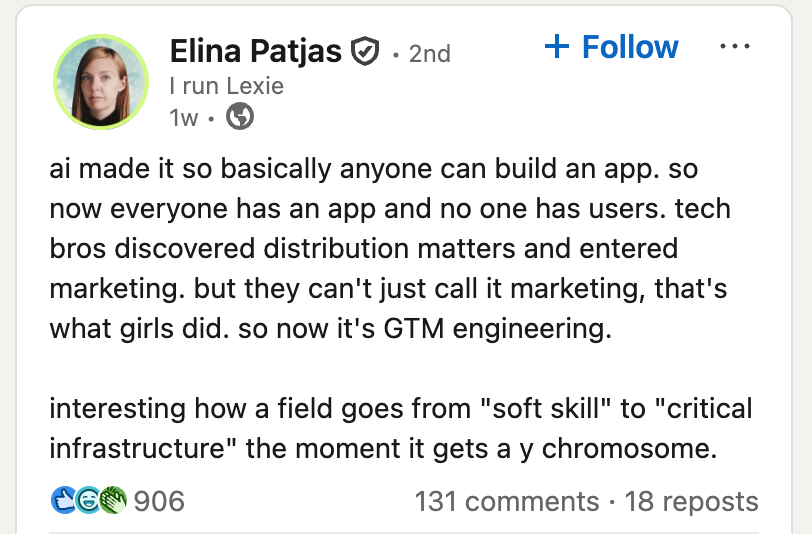
Here’s a LinkedIn post that’s been living rent-free in my head:
I’ve been thinking about this because, where do marketers go from here?
The distinction between marketing and engineering used to be structural. Engineers built things. Marketers sold things. One group shipped product. The other wrote copy about the product that shipped. The line was clean.
In most tech companies, the engineering org was where budget lived, where respect lived. Marketing was downstream. Creative but not rigorous. Strategic but not technical. Valuable but never core. The word “soft” got used to describe marketing skills, so that it stopped sounding like an insult.
And then AI changed the tooling.
Not the logic of marketing — the tooling. When a marketer can build a landing page, wire together an automation, and connect an API without filing a ticket, the clean line between “builder” and “describer” gets complicated fast.
The job started to require things that didn’t exist five years ago. Making a skill is essential. Knowing where you can automate is another.
These aren’t engineering skills. But they’re not the marketing skills of 2018 either. They’re something in between. A third category that’s been arriving and is impossible to ignore.
The industry, in its perpetual need to name things, reached for the title with the most cultural capital. Which happened to be “engineer.”
Why is marketing getting a rebrand?
Here’s where the LinkedIn post is right.
The rebranding isn’t neutral. When distribution became the bottleneck (when it turned out that shipping the app was the easy part and getting anyone to use it was the hard part), the people who’d spent their careers dismissing marketing discovered they needed it. And they did what people do when they encounter something they’ve previously dismissed: they reconstructed it in a form they could respect.
“Growth hacking” was the first wave. It took the measurable parts of marketing and made them sound like they were adjacent to code. Then came “demand gen,” which is just marketing with a spreadsheet in the room. Now we have “GTM engineering,” “content engineer”, and the “marketing engineer.”
Each reframing coincided with the field attracting people from technical backgrounds who needed permission to find it interesting. Why? Because if it’s not engineering, it’s overhead. So you make it sound like engineering.
And then, yes, people who’d been doing the underlying work for years watched a field they built get renamed by people who arrived late and needed a more flattering vocabulary for their arrival.
Somebody, stop these silly titles.
Does marketing need a rebrand?
But here’s where the LinkedIn post stops short.
Everyone’s building. At some point, I had to actually ask myself: What am I doing right now? Is this engineering? Is this marketing? Is there a name for the person who does both as a matter of course and doesn’t think much of the distinction?
The honest answer is that I’m using technical tools to execute marketing strategy faster and more precisely. That’s not engineering. It’s also not the marketing of five years ago. It’s emerging and evolving.
The question is whether we need a new title for it, or whether “marketing” was always a big enough container.
I think it was always big enough.
Are these titles even accurate?
Remember, good positioning isn’t about what’s true. It’s about what lands in the mind of the person you’re trying to reach. A good product in the wrong category is a failed product. The same logic applies to roles and to the people who hold them.
If “GTM engineer” gets you taken seriously in rooms where “marketing manager” doesn’t… the question isn’t whether the title is accurate. The question is whether you want to spend your career being right about what you should be called, or actually doing the work and getting credit for it.
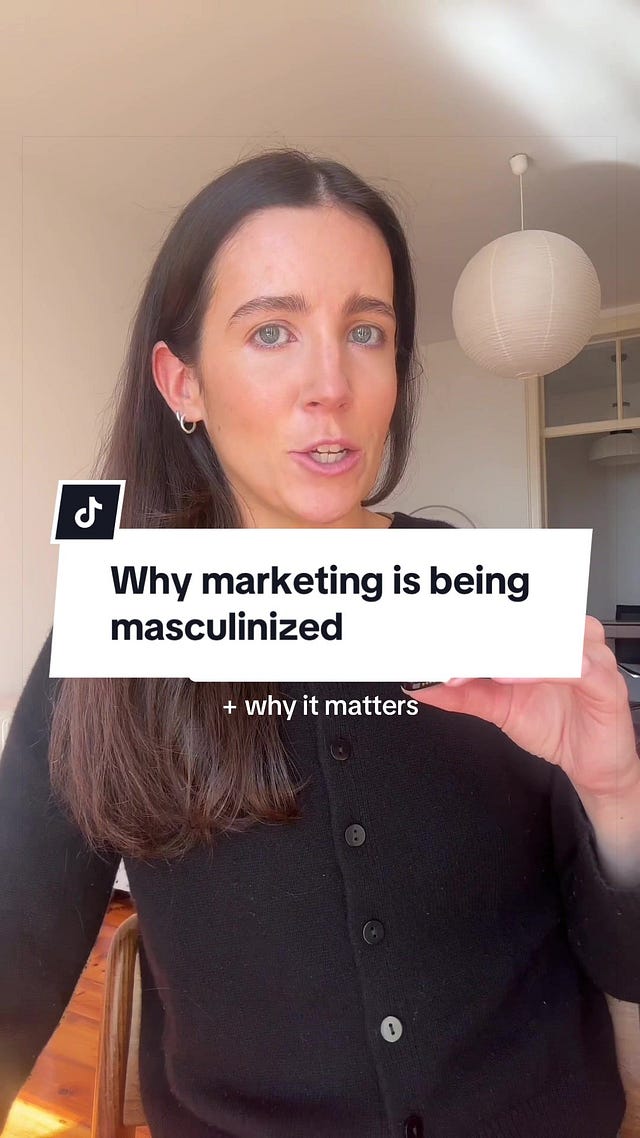
So, is marketing becoming masculinized?
Was it a feminine job to begin with?
 Tiktok failed to load.
Enable 3rd party cookies or use another browser
Sort of?
Marketing has been coded as feminine labor for decades: relationship work, communication work, the emotional labor of understanding audiences and building trust. These are also the skills that are hardest to quantify, which makes them easy to devalue.
Then AI made it possible to do marketing things with code. Now, marketing gets revalued when the people doing it change, not when the work itself changes.
But the actual work (understanding why people make decisions, building categories before they exist, making complex things legible, distributing ideas until they stick) hasn’t changed. It was never soft.
You don’t have to be an engineer to be important (?)
The phrase “GTM engineer” doesn’t bother me because it’s inaccurate. It bothers me because it implies the work only became important when it became “engineering” or when tech bros realized they needed users.
Everyone is not an engineer now.
Marketing today is also different from marketing five years ago, but that doesn’t make it engineering.
The core of marketing does not change. And even then, so many of us have imposter syndrome… hence, the name of this Substack. Let me decide that first.
am i... a marketer? is a newsletter about the weird, specific experience of working in marketing right now. if this resonated, share it with someone who’s in the thick of it.


🤖 Messing with Claude Design & MindStudio
🌉 Sign up for The Anti-Busy Club: Build an Agent with Gumloop x Toast, happening in early May! Events I’m attending/want to attend next week:
a16z speedrun cafe @ Sohn (Apr 20-25)
Women + AI: The Spring Table (Apr 20)
Design & Dine with v0 & Toast (Apr 21 — I’m hosting!)
Design Night with Vercel and Notable (Apr 22)
Build After Dark (Apr 22)
AI Happy Hour (Apr 23)
SF GTM Social (Apr 23)
If you find this interesting, you can find me on LinkedIn! We don’t have to do that, though. You can also find me on X and Instagram.
🛜 See you on the internet! 🌐