

does billboard = success?
101ads.org


I’m was just in SF for Config. It’s always a little jarring driving into SF. When you’re on the 101, you know you’re back in AI county.
AI startups (and tech in general) dominate the billboards along the highway. I started counting how many I recognized and how many I didn’t the first time I drove down.
Having been here for a while now, I recognize most of it, but I don’t know what they mean. They plaster “AI” and “agentic” everywhere without defining how their software solves problems (yet still claim to be revolutionary).
It has the energy of a coup that forgot to plan past day one. Oh, and it’s all looking the same. None of them truly stand out… except PostHog?! I’ve been liking how quirky their ads are. Truly the daddAI of billboards. I really like this bus ad!
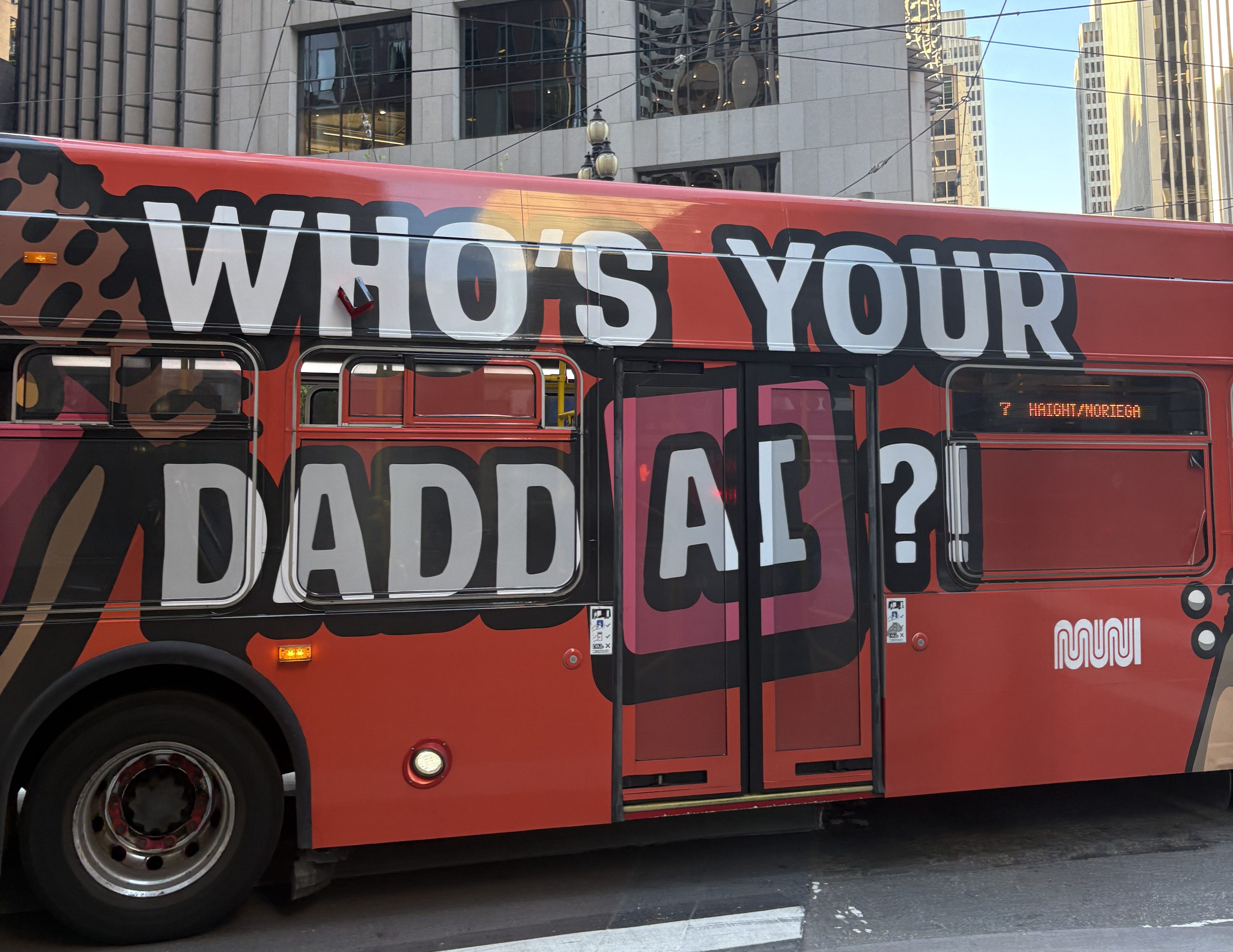
They even got the spacing right across the bus! Making sure the AI, in particular, was on the door. I should probably cover a few woopsies that I’ve seen around SF. I also wonder how bus ads perform vs. billboards.
Billboards are everywhere
Commuting in SF is one obvious example. The word “agentic” has probably appeared on at least three bus shelters within a half-mile of where you live. But I was walking around New York and Portland recently, and it’s not that different. Portland shocked me. Gamma had a billboard in Seoul while I was visiting earlier in the year.
Billboards are a thing, and I feel bad for commuters. I also feel bad for marketers because what does all this mean for us?
What I want to know is whether any of this is durable and helps companies or marketers reach their goals. Whether that’s ARR or career advancement... What does it mean for all of us? As a business, as a marketer, as a marketing team?!
Is OOH the new COTD (channel of the day) for marketers?
OOH advertising hit a record $9.46 billion in US revenue in 2025, 19 consecutive quarters of growth, with digital OOH accounting for 36.3% of total OOH revenue, increasing 10.5% year over year…
If you’re wondering why all these billboards are so tech-heavy, 28% of the top 100 OOH advertisers were technology or direct-to-consumer brands, with 16% more than doubling their investment year over year. Insane numbers, eh?
Why are companies and marketers looking towards billboards as a channel?
OOH is having a moment because everything else got harder. Remember Andrew Chen’s Every marketing channel sucks right now?
While I don’t 100% agree with it, I can empathize with where he’s coming from, especially in 2026. The channels that worked in 2015 are now fully mature, fully bid up, and fully ignored by the audiences you’re trying to reach. Companies are grilling marketing teams about it.
SEO
What’s made recent times feel different is that several major channels are undergoing structural changes that won’t reverse thanks to AI and agents. SEO, for example, has suffered recently. And the rise of GEO, LLMO, and AI search…? You know how I feel about it.
Google search traffic to publishers dropped globally by a third in the year to November 2025. Zero-click searches increased from 56% to 69% between May 2024 and May 2025 as Google answered questions before anyone clicked. All of this makes attribution and forecasting harder.
Most publishers who responded to a Reuters Institute survey said they expected to put less effort into traditional Google search in 2026. I think that’s a mistake, but that’s what a lot of people I know are thinking.
Paid digital
Paid digital also got messier. Roughly 1/3 of internet users globally use ad blockers, with estimates in the US around 32%. And the six-year saga of Google’s privacy sandbox ended not with cookie deprecation but with its opposite: Google retired all 10 privacy sandbox APIs in October 2025 after low adoption killed the initiative. The replacement for cross-site tracking never arrived.
Third-party cookies remain in Chrome with no timeline for removal. Extended ambiguity and six years of industry preparation for infrastructure that still doesn’t exist. The tracking environment is unstable, which, once again, makes forecasting hard and attribution harder.
Creator or influencer marketing
The global creator/influencer market hit $32 billion in 2025, and the aggregate ROI numbers look good on paper, but those numbers are mostly driven by e-commerce and consumer brands with clean purchase attribution.
For B2B, the picture is murkier: measuring ROI and attribution complexity account for nearly 16% of reported challenges, and minimum commitments at agencies have pushed into the $20k+ range for anyone building a real program. I learned this the hard way 😢. It’s a significant budget commitment for a channel you can’t cleanly measure, and for an audience you’re not sure exists.
Big vs. small, digital vs. physical
Big & digital marketing channels are either declining, getting more expensive, becoming more unstable, or losing the measurement infrastructure they relied on. So, are companies shifting towards smaller, physical channels where their competition isn’t present yet? Where does this billboard fit into all of this?
The billboard is, by definition, a big channel. While the alternatives feel unstable, a billboard is physical. Leadership can drive past it and get a certain high off it, which gives marketing teams some breathing room.
It also photographs well for a LinkedIn post. You’d be surprised how much of it is because of the last part. Scroll through your LinkedIn now!
I was in a Clay webinar recently, and for better or worse, there’s a perception that companies on billboards are legit. This helps elevate your brand.
I, by the way, really like Clay’s billboards! The copy is great.
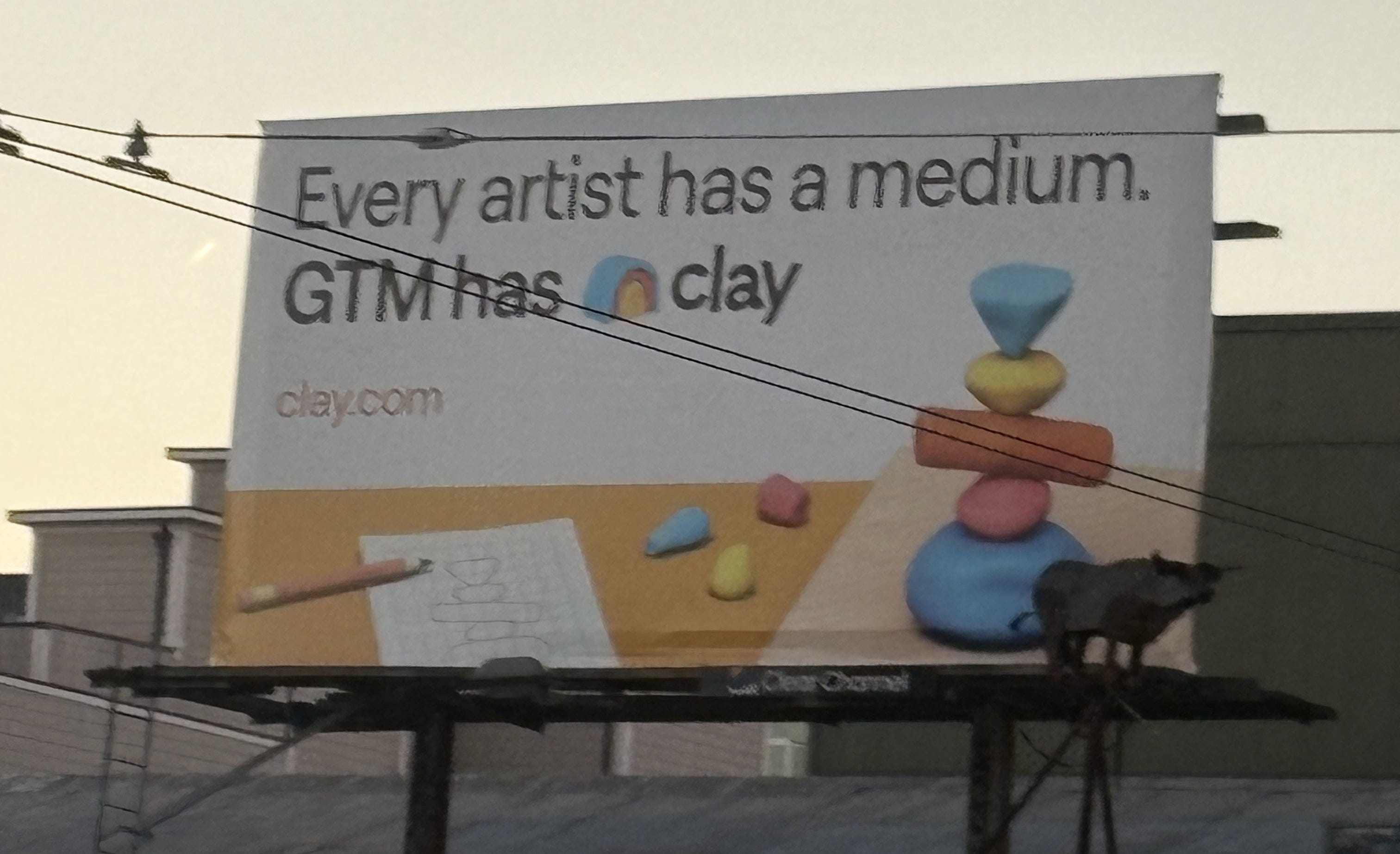
Billboards, for better or worse
I think the perception that companies on billboards are legit is for the worse. The companies that are good, though, view any marketing channel as an extension of their clear point of view, defined audience, and creative voice that doesn’t need the medium to carry it. OOH becomes proof of it, not the source of it.
When companies don’t have that clarity, the billboard exposes it. The copy doesn’t make sense, and there’s no “what’s next” or “so what”, so you drive past it, and that’s kind of it. You can plaster it all over LinkedIn, but self-praise is not praise. Ideally, you want your audience to post it all over their LinkedIn.
Most companies attribute the lack of results to the channel, rather than to the lack of clarity they had going in. They don’t learn their lesson.
Brand awareness is also something you invest in with the understanding of delayed, compounding impact: emotional connection, improved ROI on events in the same market, and getting in front of your audience consistently. That compounding only happens if what you’re building awareness for is already worth being aware of.
A billboard can make you famous. It can’t make you good.
Does it make you a better marketer?
The billboard doesn’t make you a better marketer, but the work required to justify and pull it off might. Similar to other projects you may take on as a marketer.
What OOH demands (when taken seriously) is pre-commitment discipline that digital channels don’t require. You can’t A/B test a freeway. You can’t optimize creative mid-flight once it’s up. You have to live with it. There’s also not much literature out there on what to do… which is why I’m very glad Matt wrote something about it.
Clay’s approach is another clear illustration of what good thinking for OOH looks like. The goal wasn’t just “brand awareness” but to make the brand familiar with a specific ICP during specific windows. Conference weeks, when buyers were physically concentrated in the right cities, etc., and to track Gong mentions afterward to see if they showed up in sales conversations.
The goal was clear before the campaign ran, so it was measurable. They defined how they would measure it with Gong.
I think this is where most companies fall apart.
The default is not to spend time on creative or copy, focus on “shipping fast,” and then rely on a third-party measurement service (somewhere between $10k and $25k). For example, device ID tracking, to map people who passed the billboard to those who visited the site. The problem is that the method is losing accuracy as the privacy landscape tightens, and OOH campaigns are hard to model anyway.
The alternative is to build rather than buy. Matt did this! He built his own tool and open-sourced it to track OOH ROI, skipping the $10-25k third-party measurement services. If you’re building, though, you must understand your funnel well enough to model it. Make defensible choices about which markets are comparable and explain why. This takes good marketing thinking, billboard or not.
That is what makes you better. Not the billboard.
Should you hire someone because they ran billboards?
SF is funny. Founders here hire marketers based on “their billboards are everywhere” or “they went viral on Hacker News”. I can empathize. Marketing is expensive, results are often intangible, and visible proof feels like the closest thing to certainty you’re going to get.
But visibility and foundation are different things. The decision not to buy the billboard because the audience fit wasn’t there, or the budget was better spent elsewhere, might be completely invisible. That’s less likely to be on LinkedIn.
Many of the billboards also flop. Did their billboard age well? Was it impossible to miss in a bad way? I’ve seen billboards that spark debate but don’t necessarily age well and might go down in billboard history as a meme. Although that would have stood the test of time... would you want your name on it? Do you want to be known for that billboard?
What you actually want to know is what happened around the initiative. Not whether they ran one... that’s part of the job and a very basic part. Some marketers never get the shot at a billboard because they don’t work at companies with unlimited VC funding. That doesn’t make them worse at thinking.
The thinking is what applies to every marketing decision you’ll make together. So instead of asking about the billboard, ask about the thinking:
What did you want to happen, and how did you know if it did?
What did you push back on, and why?
What would you do differently?
What’s a bet you made that didn’t have clean attribution, and how did you defend it?
What foundational work did you do before any channel decisions were made?
What you’re trying to figure out when you hire a marketer is whether they know what “working” means and if you’re both on the same page on the definition. Whether they’ll push back when something is expensive and hard to measure, or whether they’ll execute and let you find out later. Whether their feedback loop is their own judgment or whatever the dashboard says. etc. etc.
Someone who can answer those questions (about a billboard, a content strategy, a product launch, anything) is showing you the judgment you’re actually hiring for. Someone who can operate in ambiguity, make a defensible call, and explain it to you afterward without needing a vendor report to back them up.
Of course, none of this works if you don't trust the person you hired to begin with. But that's a topic for another day.
am i... a marketer? is a newsletter about the weird experience of working in marketing right now. if this resonated, share it with someone who’s in the thick of it.
🤖 Messing with motion and brand design!
🌉 I’m off to Europe, and there’s the World Cup!! Get out and play or watch some sports 🙂
If you find this interesting, you can find me on LinkedIn! We don’t have to do that, though. You can also find me on X and Instagram.
🛜 See you on the internet! 🌐
I am legit about to start a Substack series called sold or scrolled on sf ai ooh 😂 posthog is so contentious! But you know what they are standing out for sure